Nuts and mortality
Two large cohorts and a twenty-study meta-analysis link a small daily handful of nuts with lower mortality. Consistent, graded, and still observational.
goodWell supported, with the usual caveats about effect size.Revised 30 Sept 2026
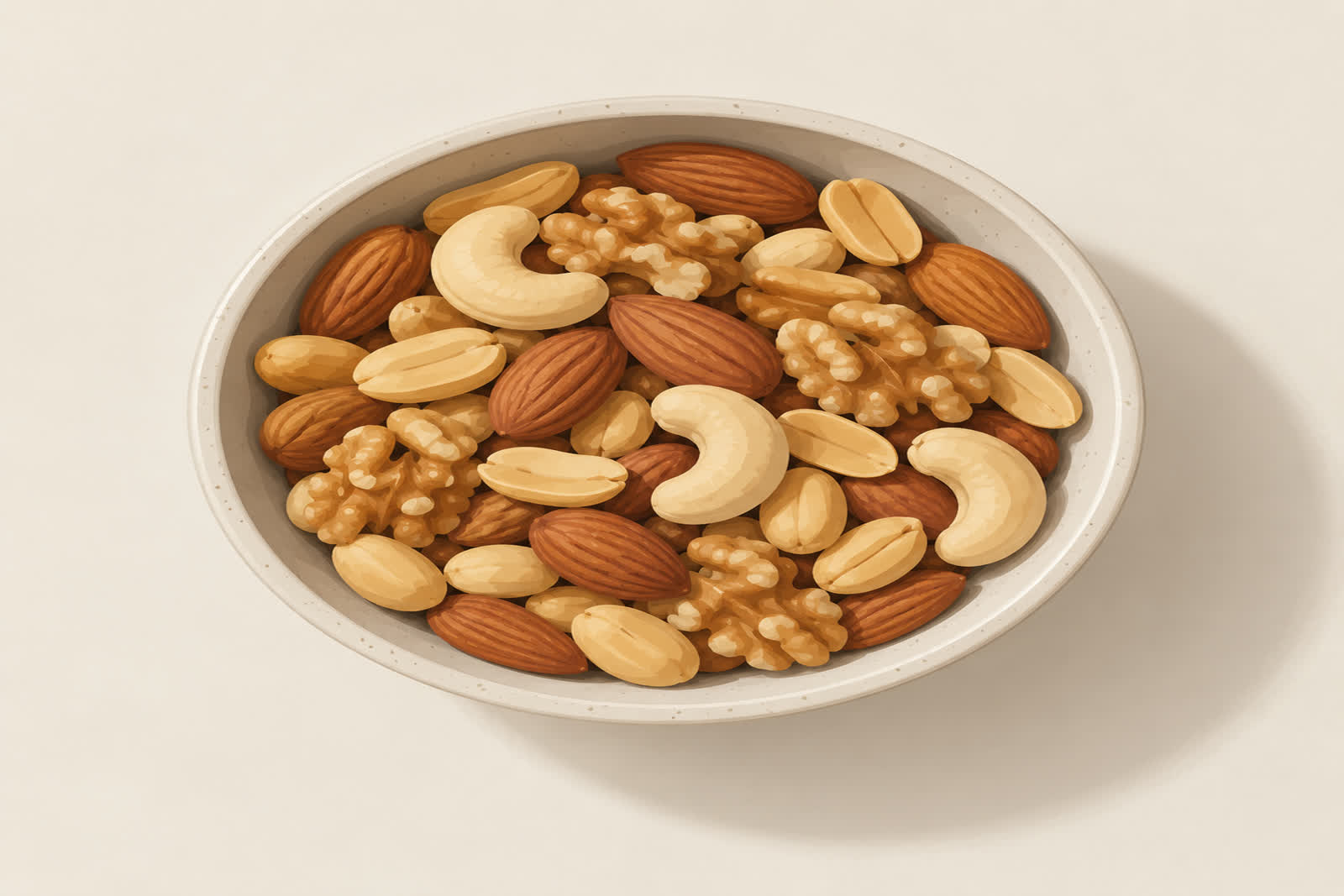
About a handful a day. The benefit plateaus, the calories do not.
The cohorts
Bao and colleagues followed two of the largest health cohorts ever assembled, American nurses and male health professionals, for a combined three million person-years. Over 27,000 deaths were recorded. After adjusting for known risk factors, nut eaters died more slowly than abstainers at every frequency measured: hazard ratios of 0.93 for less than once a week, sliding to 0.80 for seven or more times a week, with a trend too steady to be noise. The same pattern held for deaths from cancer, heart disease and respiratory disease.
Three million person-years is the kind of weight most nutrition findings never get. It still cannot randomise anyone.
The pooled picture
Aune and colleagues gathered twenty prospective studies and modelled intake by the gram. Per extra 28 grams a day, roughly a small handful, the summary relative risks were 0.71 for coronary heart disease, 0.79 for cardiovascular disease, 0.85 for total cancer and 0.78 for all-cause mortality. Stroke sat at 0.93 with a confidence interval crossing one: no claim there. Tree nuts and peanuts looked similar, which is mildly embarrassing for anyone paying triple for macadamias.
The authors also ran the counterfactual: if the associations were causal, nut intake below 20 grams a day would account for an estimated 4.4 million premature deaths in 2013 across the Americas, Europe, Southeast Asia and the Western Pacific. That number is arithmetic built on an assumption, not a body count. It shows the size of the prize, not proof it can be collected.
Why the nut gets too much credit
Nobody eats nuts in isolation. In every cohort, frequent nut eaters also smoke less, move more, eat more vegetables and see doctors more often. Statisticians adjust for all of that and the signal survives, which is genuinely impressive, but adjustment is not erasure: whatever questionnaires miss stays in the number. The honest reading is that a handful of nuts marks a pattern of eating and living, and may contribute a little of its own through unsaturated fats, fibre and minerals.
Nuts look like a cause and behave like a marker. Buy the handful, not the halo.
Using it
A small unsalted handful most days is cheap, portable and hard to get wrong, provided it replaces something worse rather than joining it. Nuts are calorie-dense, around 160 to 180 kilocalories per handful, so the benefit curve the studies trace flattens while the energy bill keeps climbing. Salted bar mixes and honey-roasted coatings trade the point for the coating.
What the data do not show
No trial has randomised people to nuts for years and counted deaths, so causality is unproven and may stay that way: the trial would be enormous and nobody would stay blinded. The cohorts are mostly white American professionals, and nut questionnaires are notoriously approximate. Allergies make the whole question moot for a meaningful minority. And nothing here says more is better past the handful: the intake curve the studies trace bends flat, which is exactly where overeating starts.